
If you are planning for personal finances and a family budget in Alberta or calculating take-home salary, it requires getting to know “how much you owe in provincial and federal income taxes in AB. Estimating your income tax liabilities in Alberta manually can be complex. Because, Canada uses a multi-tiered, progressive, and marginal income tax system.
An Alberta income tax owe calculator 2026 helps you convert gross income into accurate net pay by applying bracket taxes and indexing, mandatory payroll contributions, and tax credits. This article helps you find the best Alberta Income Tax Owe Calculator 2026.
It helps you understand the federal and provincial income tax rate brackets and how the calculator works. It helps you know how mandatory contributions like CPP & EI Premiums affect income tax.
Table of Contents
How Alberta Income Tax Calculation Works?
Your total AB Income tax responsibilities consist of two separate calculations:
(i) Alberta provincial Income Tax
(ii) Canada Federal Income Tax.
Both systems use marginal tax brackets. That means each part of your income is taxed at its corresponding rate instead of the entire salary being taxed at a single flat income tax rate or percentage.
To calculate the income tax owed, you can use our Alberta income tax owe calculator 2026. It applies progressive tax rates to taxable income. It also helps compute the total gross tax. It then subtracts non-refundable tax credits like the Basic Personal Amount (BPA).
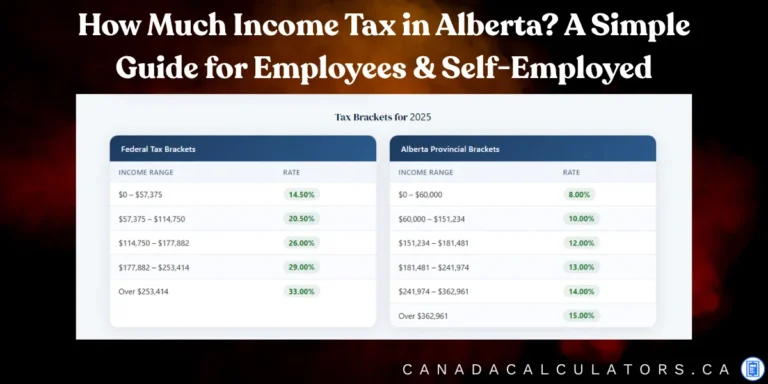
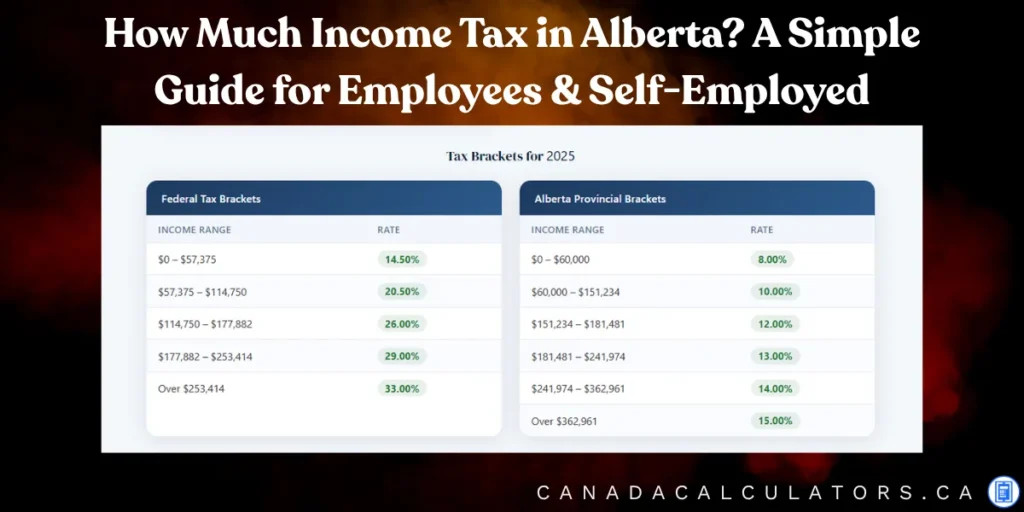
Alberta Provincial Income Tax Brackets for 2026
Alberta provincial government offers one of the most competitive personal income tax structures in Canada. The province provides a designated lower rate on income up to $61,200, alongside indexation across all thresholds:
| Taxable Income Tier | Provincial Tax Rate |
| Up to $61,200 | 8.0% |
| $61,200.01 to $154,259 | 10.0% |
| $154,259.01 to $185,111 | 12.0% |
| $185,111.01 to $246,813 | 13.0% |
| $246,813.01 to $370,220 | 14.0% |
| Over $370,220 | 15.0% |
Alberta province maintains the highest BPA in the country. It is indexed above $22,000. The first portion of your income is applicable for zero provincial tax liability.
Canada Federal Tax Brackets for 2026
Without having an impact of which province you live in, federal income tax rates are applied uniformly across Canada. For the 2026 taxation year, the Canada Revenue Agency (CRA) uses the following marginal brackets:
| Federal Taxable Income Tier | Federal Tax Rate |
| Up to $58,523 | 14.0% |
| $58,523.01 to $117,045 | 20.5% |
| $117,045.01 to $181,440 | 26.0% |
| $181,440.01 to $258,482 | 29.0% |
| Over $258,482 | 33.0% |
When you use the Alberta income tax owe calculator 2026 on CanadaCalculators.ca, the tool combinely applies the provincial and federal brackets to generate your combined marginal tax rate.
Compulsory Contributions from Payroll (CPP & EI)
Your net payment is structured not only by income taxes but also by fixed withholdings:
- Canada Pension Plan (CPP): Standard CPP contributions apply up to the Year’s Maximum Pensionable Earnings (YMPE). Additionally, the enhanced second tier (CPP2) imposes an additional contribution on earnings between the YMPE and the upper earnings limit.
- Employment Insurance (EI): Standard EI premiums are also deducted up to the annual maximum insurable threshold from the payrolls of employees.
Our Alberta income tax owe calculator 2026 considers all of these payroll deductions alongside standard taxes to get the actual net take-home earnings.k
Step-by-Step Calculation: An $85,000 Salary Example
If you wish to check how tax liability is calculated in Alberta, let’s understand this with an example of an employee whose annual gross salary is $85,000.
Provincial Tax Breakdown
- First $61,200 of income ($85000) will be taxed at 8%: $4,896
- Remaining income = $23,800 ($85,000 − $61,200) will be taxed at the next rate of 10%: $2,380
- Gross Provincial Tax = $4896 + $2380 = $7,276
- Subtract or Minus Provincial BPA Credit: Approx. $1,785
- Net Provincial Tax: $7276 – $1785 = $5,491
Federal Tax Breakdown
- First $58,523 will be taxed at a rate of 14%: $8,193.22
- Remaining $26,477 ($85,000 − $58,523) will be taxed at the rate of 20.5%: $5,427.79
- Gross Federal Tax: $13,621.01
- Subtract Federal BPA Credit: ~$2,303
- Net Federal Tax: ~$11,318
Total Combined Deductions
- Total Income Tax (Provincial + Federal): ~$16,809
- CPP & CPP2 Contributions + EI Premiums = $4,100 + $1,050 = $5150
- Estimated Net Annual Pay: ~$63,041
This calculation can be done by using the Alberta income tax owe calculator 2026. An effective tax rate of 19.8%, despite a combined top marginal tax rate of 30.5% (10% provincial + 20.5% federal).
Tax Liability: Salaried Employees vs. Self-Employed
While standard income tax rates remain similar regardless of how income is earned, payment systems and total tax liabilities differ significantly between employment types:
| Employed (T4) | Self-Employed / Sole Proprietor |
| Taxes deducted at source | No automatic tax withholdings |
| Employer pays 50% of CPP | Must pay both employee and employer CPP portions (11.9%) |
| Eligible for EI safety nets | Generally responsible for own EI coverage |
| Limited expense deductions | Can deduct eligible business-related expenses |
| Simple annual filing | May require quarterly CRA instalment payments |
Business owners and gig workers can use the Alberta income tax owe calculator 2026. They should consider the full self-employed CPP rate and plan to reserve roughly 25% to 30% of gross invoice revenue for year-end tax settlements.
Tips to Reduce the Income Tax Owed in Alberta
You can reduce your net tax payable and keep your income bracket rates efficient using legal tax-reduction systems:
- Registered Retirement Savings Plan (RRSP): RRSP contributions help you reduce taxable income dollar-for-dollar. For a taxpayer in a 30.5% marginal bracket, a $10,000 RRSP deduction can reduce tax roughly by $3,050.
- First Home Savings Account (FHSA): Being eligible as a first-time homebuyer can save up to $8,000 annually in tax. Investment growth and withdrawals remain tax-free for home purchases.
- Medical and Donation Credits: Non-refundable tax credits help offset gross tax liabilities directly. This helps transform out-of-pocket healthcare expenses or charitable gifts into bottom-line tax relief.
Using an Alberta income tax owe calculator 2026 helps you estimate and consider adjustments such as RRSP deductions or changes in salary before tax deadlines arrive, giving you a clear estimate of your net earnings and tax balance.
Frequently Asked Questions
What is the lowest provincial personal income tax rate in Alberta for 2026?
Taxable income up to $61,200 is taxed at 8%. It is the lowest rate of Alberta Income tax brackets.
What is the Alberta Basic Personal Amount (BPA) in 2026?
The Alberta Provincial BPA is $22,769 (increased by 2% from 2025). This provides a non-refundable provincial tax credit of $1,821.52 ($22,769 × 8%). This works against your gross provincial tax liability.
How does the Alberta Income Tax Owe Calculator determine your marginal vs. average tax rate?
The marginal tax rate is the combined federal/provincial percentage paid on your last dollar of income. The average or active rate is your total net tax payable divided by total gross income.
How do RRSP contributions reduce tax owed in the Alberta tax calculator tool?
Registered Retirement Savings Plan contributions directly reduce your net taxable income at your highest marginal bracket. Tax Savings = Contribution x Marginal Rate.
How are capital gains taxed in the Alberta income tax calculation?
For individuals, the first $250,000 in net annual capital gains has a 50% inclusion rate, and more than this is subject to a 667% inclusion rate added to taxable income.
How does the First Home Savings Account (FHSA) deduction factor into tax estimates?
Qualifying annual FHSA contributions (up to $8,000 per year) are fully exempt against your taxable income at top marginal rate, mirroring RRSP tax deductions.
How are eligible Canadian dividends taxed under Alberta personal income tax?
Eligible dividends are earned up to 38% on your taxable income calculation. This is offset by combined federal and provincial non-refundable Dividend Tax Credits (DTC).
What are the official tax filing deadlines for the Alberta income taxes?
Most individuals must file and pay their taxes by April 30, 2027, while self-employed individuals can file by June 15, 2027, but their tax payment is still due by April 30, 2027.
How do CPP/CPP2 & EI payroll deductions affect your tax owed?
Mandatory CPP/CPP2 and EI contributions generate non-refundable federal and provincial tax credits. These credits are calculated at the lowest bracket rate (14% federal + 8% Alberta), directly reducing the net tax owed.