
Millions of people run their own separate businesses, do freelance work, or provide contract-based services in Canada. It obviously offers autonomy and flexible scheduling, and unlimited potential of earning. However, unlike salaried employees, who automatically receive government employment insurance benefits through EI premium deductions.
It works like a financial safety net for employed workers. On the other hand, independent contractors and self-employed people need to build their own financial security through EI Benefits for Self-Employed. They need to pay EI Premiums to get the benefits while they are not able to work and earn from their business.
To fill this gap between employee EI benefits and EI benefits for self-employed systems, Service Canada allows business persons and freelancers to access Self-employed Employment Insurance benefits through manual enrollment with the Canada Employment Insurance Commission (CEIC).
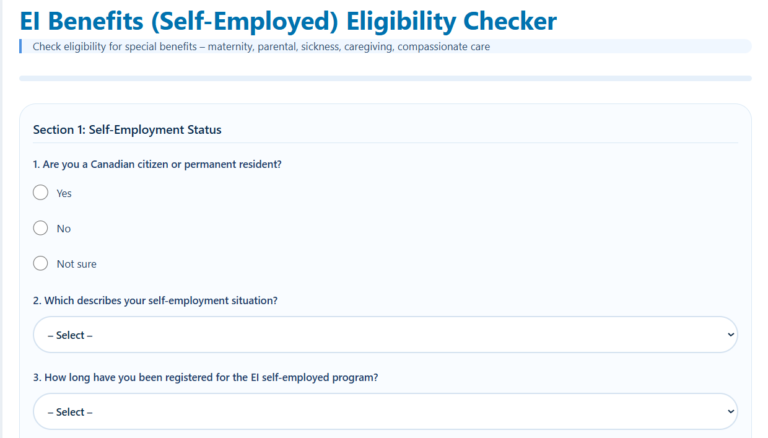
This tutorial covers how EI benefits for self-employed individuals work, what streams are available, how EI premiums are calculated for self-employed EI beneficiaries, and how to evaluate whether opting into the program fits your overall business strategy.
Table of Contents
Employment Insurance Benefits for Self-Employed: At a glance
| Features | Details |
| Benefit Types Available | Sickness, caregiving, compassionate care, Maternity & Parental benefits |
| Exception Quebec | Quebec uses QPIP for: Maternity, Paternity, Parental, and Adoption benefits |
| Eligibility | Self-employed, Shareholders in a business, Work-reduction Agreement requirements |
| 2026 Premium Rate for Self-Employed Person | $1.63 per $100: Out of Quebec $1.30 per $100: in Quebec |
| Maximum Premium | $1,123.07 outside Quebec$895.70 in Quebec |
| Tax Filing | File Schedule 13 with annual tax return |
| Registration | Through My Service Canada Account (MSCA) |
| Withdrawal | Cancellation rules depend on timing; claiming benefits can trigger permanent participation |
What Are EI Benefits for Self-Employed Individuals?
According to the standard Employment Insurance Act, self-employed people are not eligible for regular EI benefits. They are qualified for EI Benefits if their business faces a market slowdown and ceases operations. Independent self-employed workers are required to register for EI special benefits. These special benefits provide temporary income replacement when serious life disruptions occur, such as:
- Severe medical issues
- The birth of a child or adoption
- Emergency family care needs
- Prevent you from operating your venture.
Available EI Benefits for Self-Employed People
| EI Self-Employed Benefit | Maximum Duration | Purpose |
| Sickness Benefits | Up to 26 weeks | Illness, injury, surgery, or quarantine |
| Maternity Benefits | Up to 15 weeks | Pregnancy and childbirth recovery |
| Parental Benefits – Standard | Up to 35 weeks | Newborn or adopted child care |
| Parental Benefits – Extended | Up to 61 weeks | Extended newborn or adopted child care |
| Family Caregiver – Children | Up to 35 weeks | Care for a critically ill/injured child |
| Family Caregiver – Adults | Up to 15 weeks | Care for a critically ill/injured adult |
| Compassionate Care | Up to 26 weeks | Palliative or end-of-life care |
Quebec System for EI Self-Employed Benefits
Quebec runs the Québec Parental Insurance Plan (QPIP), which manages all maternity, paternity, parental, and adoption benefits provincially. Self-employed residents of Quebec can access federal EI benefits only for sickness and caregiving benefits. They need to pay reduced federal premium rates as a result.
Self-Employed EI Benefits Eligibility
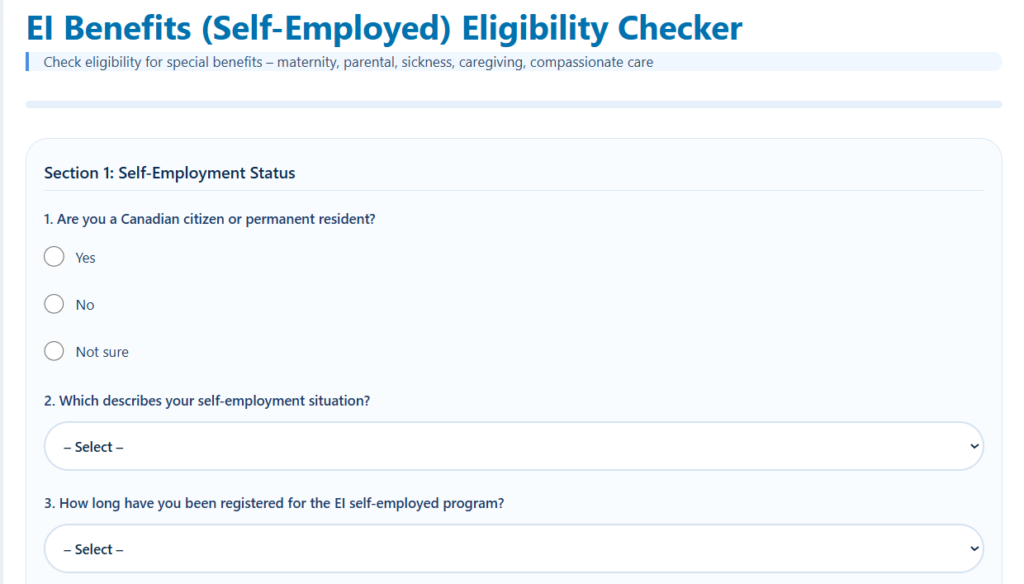
To access EI benefits for self-employed workers, you must satisfy five statutory criteria:
| Eligibility Requirement | Explanation |
| Residential Status | Canadian citizen or permanent resident |
| Business Ownership | Sole proprietor; partnership: control more than 40% of the voting shares |
| Operational Interruption | Business activity must decrease, and income reduced by more than 40% for at least 1 week |
| Minimum Annual Earnings | At least $9,254 net self-employment income in the previous year for EI benefits in the current year |
| 12-Month Vesting Period | CEIC agreement must be active for at least 12 months before claiming |
EI Benefit Payouts and Weekly Rates for Self-Employed
The most common question among self-employed workers is: how much can I expect if I qualify for EI benefits as a self-employed worker?
For most special benefits, cover weekly payments equal to 55% of your average weekly net earnings. This is also available up to an annual fixed threshold, or Maximum Insurable Earnings (MIE).
| Factor | Standard Canadian Provinces & Territories | Quebec Residents |
| Maximum Insurable Earnings (MIE) | $68,900 | $68,900 |
| Maximum Weekly Benefit Rate | Up to $729 per week | Up to $729 per week |
| Benefit Calculation Rate | 55% of net weekly insurable income | 55% of net weekly insurable income |
| Tax Status | Fully taxable as personal income | Fully taxable as personal income |
Self-Employment vs. T4 Employment
If you run a side business while employed in a company on a T4 payroll, both sources of income can be considered for EI benefits. If your employer already deducts EI premiums from your salary, your insurable employment hours and your self-employment net earnings can work together to establish your benefit rate up to the maximum allowable threshold.
EI Premium and Tax File for Self-Employed
To access EI benefits for self-employed programs, freelancers and business owners are required to pay an annual premium. This premium is calculated as a percentage of your net self-employment earnings.
Where employers pay 1.4 times the worker’s rate, self-employed people pay only the employee rate. There is no employer surcharge for independent workers.
| Region | 2026 EI Premium Rate | Maximum Annual Premium | Year |
| Outside Quebec | $1.63 per $100 earned | $1,123.07 | 2026 |
| Quebec | $1.30 per $100 earned | $895.70 | 2026 |
Premiums are assessed against full calendar-year net income up to the $68,900 earnings maximum.
CRA Tax Filing with Schedule 13
Self-employed EI premiums are not remitted monthly. They are calculated and settled when you file your annual T1 personal tax return with the CRA. You must complete Schedule 13 (Employment Insurance Premiums on Self-Employment and Other Eligible Earnings) and submit it along with your tax package.
How to Register and the 12-Month Waiting Rule
Because EI Benefits for the self-employed are proactive rather than retroactive. You cannot enroll after receiving medical tests or discovering a pregnancy and claim benefits immediately.
- Visit the official website of the CRA and log in to My Service Canada Account (MSCA).
- Go to the Employment Insurance module
- Select “View my agreement status” as “self-employed”
- Accept the statutory terms.
- Get official confirmation notice verifying your start date.
Maintain your active agreement for 12 full months before submitting your first claim for EI benefits for self-employed protection.
Program Exit Rules and the Reverse Claim
Because registration is manual and voluntary, the CEIC allows participants to cancel their claims under some terms.
- If you cancel or withdraw your EI Self-Employed Benefit program within 60 days of your agreement date, you are not required to pay premiums. If you decide to register again in the future, a brand-new 12-month waiting period starts.
- If you cancel your self-employed EI application after 60 days, your agreement terminates, but you must still pay premiums on all self-employment earnings generated through December 31 of that tax year.
- Once you collect any EI special benefit payments, you are not allowed to withdraw from the EI Self-Employed Benefits. You will be legally required to pay annual EI premiums based on your net business earnings for as long as you work in a self-employed capacity in Canada.
Calculating the annual employment insurance premium limits against your potential income helps you decide whether voluntary EI benefits for self-employed coverage serve as a valuable tool for your financial well-being.
Frequently Asked Questions
What is the minimum net self-employment income threshold for EI Benefits for Self-Employed?
You are required to have at least $9,254 in net self-employment income in the previous year.
Can self-employed individuals collect EI Regular Benefits if business slows down or fails?
No. The self-employed EI program covers Special Benefits only, not Regular EI.
What is the “Lifetime Lock-in” rule?
After receiving EI self-employed benefits, you are locked in to continue paying EI premiums on self-employment income.
How are EI premiums calculated for the self-employed?
Premiums use the employee rate and are reported annually on Schedule 13 with your tax return. You can use EI Self-Employed Premium Calculator at CanadaCalculators.ca.
How much must you reduce your business time to establish a valid claim?
You must reduce your business activities by more than 40% for at least one week.
How is the weekly benefit amount calculated for a self-employed applicant?
The benefit is generally 55% of average insurable earnings, up to the weekly maximum.
How do Quebec residents handle self-employed maternity and parental benefits?
Quebec residents receive maternity and parental benefits through QPIP, not federal EI.
Can an incorporated business owner controlling over 40% of voting shares use this program?
Yes. Eligible incorporated business owners can voluntarily register for self-employed EI.
How are mixed earnings (part-time T4 employment + self-employment) coordinated?
Service Canada may combine eligible earnings when calculating benefits, subject to the annual maximum.