
Understanding EI eligibility requirements in 2026 is so important for anyone facing job loss or unstable work conditions in Canada. Unlike a fixed national Canadian government standard, the number of hours you need to qualify for Employment Insurance (EI) Regular Benefits depends heavily on where you live. The EI eligibility rules updated by Service Canada tie the employment insurance requirements this year directly to the local unemployment rate.
If you are planning a claim, you must look at EI qualifying period 2026 data trends and understand the current EI insurable hours threshold 2026 adjustments to see how they roll into this year. This guide breaks down the exact hours needed across different economic regions for 2026, explains how the Service Canada EI Qualification criteria 2026 is different from past averages, and provides actionable steps to ensure you meet the threshold.
1. The Key Rule: Hours Are Based on Regional Unemployment
The most important factor in determining your eligibility is the unemployment rate in your specific economic region at the time of your application. The formula is simple:
| Higher unemployment = Lower hours required |
| Lower unemployment = Higher hours required |
According to the Employment Insurance Act, to adhere EI Eligibility Requirements in 2026, you generally need between 420 and 700 hours of insurable employment in your “qualifying period” (usually the 52 weeks immediately before your claim). The number is not arbitrary; Service Canada updates these thresholds every four weeks based on Statistics Canada data.
As of the March 2026 period, here is how the numbers break down in some of Canada’s major and outlier regions :
| Economic Region | Unemployment Rate (Mar 2026) | Insurable Hours Required |
| Northern Manitoba | 26.5% | 420 hours |
| Northern Saskatchewan | 14.1% | 420 hours |
| Windsor, ON | 9.4% | 560 hours |
| Toronto, ON | 7.9% | 630 hours |
| Calgary, AB | 6.8% | 665 hours |
| Vancouver, BC | 6.3% | 665 hours |
| Halifax, NS | 5.8% | 700 hours |
If you live in a major metropolitan area like Toronto or Vancouver, you almost always fall into the higher threshold (665-700 hours). Always check the Service Canada “EI Program Characteristics” page for your postal code.
2. Understanding the “Qualifying Period” in EI Eligibility Requirements in 2026
You cannot just count hours from any point in your career. The EI qualifying period 2026 and 2026 standards refer to the look-back window.
- Standard Window: The 52-week period immediately before the start date of your claim.
- Extended Window: If you were sick, injured, pregnant, or in jail (and not found guilty) during that year, the period can be extended up to 104 weeks to give you a fair chance to accumulate the needed hours.
“Hours worked before the start of the 52-week window do not count. The Social Security Tribunal frequently dismisses appeals where claimants rely on old hours but failed to work enough in the immediate year before applying”.
3. How to Calculate If You Qualify (Examples)
Let’s translate hours into real-world work scenarios to follow EI Eligibility Requirements in 2026:
- Scenario A: Part-time Worker in Toronto (630 hours needed). If you work an average of 20 hours per week, you need to have worked at least 31.5 weeks (or about 8 months) in the last year. If you took a 4-month break last summer, you likely will not qualify, even if you worked full-time the year before.
- Scenario B: Full-time Worker in Calgary (665 hours needed). A standard 35-hour week meets this in 19 weeks (just under 5 months). If you just switched jobs and have worked steadily for 6 months, you are safe.
- Scenario C: Seasonal Worker in Northern Manitoba (420 hours needed). You can qualify with just 12 weeks of full-time work, acknowledging the scarcity of year-round employment in remote areas.
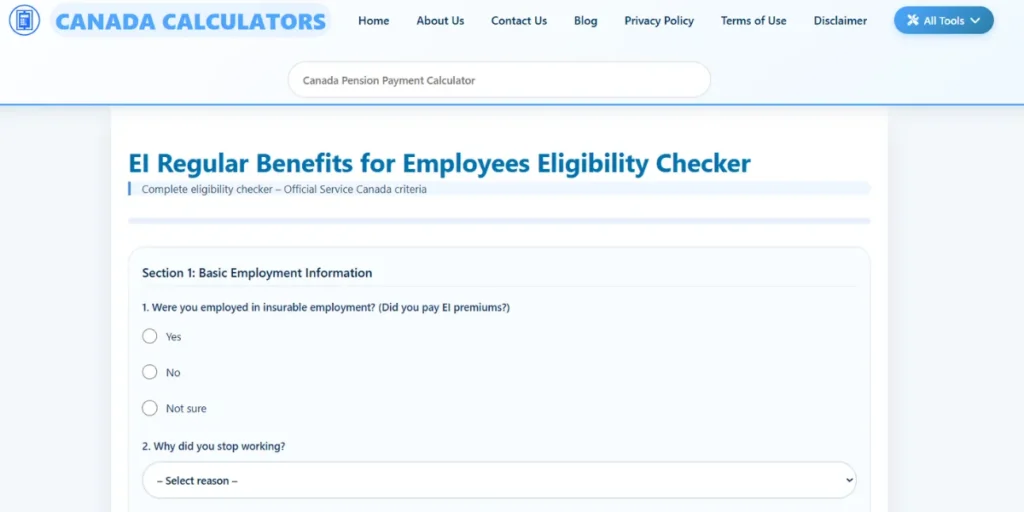
- Here is a simple way to calculate the El Regular Benefits at canadacalculators.ca where you can check your eligibility with just a few clicks, and you can estimate your regular benefits whether you are a farmer, fisher, teacher, or self-employed.
4. Why the 2026 Numbers Are Different (The 2026 Hangover)
You may notice references to EI eligibility requirements 2026 having slightly different thresholds. As inflation cooled and the labor market adjusted in late 2026, many urban unemployment rates crept up. Consequently, some regions shifted from the 700-hour maximum down to 665 or 630 hours in 2026. However, if you are in a major city, the relief is minimal; you still need significantly more work history than someone in a rural area.
5. Special Exceptions: Sickness, Maternity, and Violations
- Special Benefits: For sickness, maternity, or parental benefits, the magic number is generally 600 hours across the country, regardless of where you live. This makes qualifying for medical leave more predictable than regular layoff benefits.
- Violations: If you had an EI “violation” (e.g., fraud or false statements) in the last 5 years, your required hours increase. For example, a region that normally requires 420 hours might require over 700 hours for someone with a prior penalty.
6. What If You Are Short on Hours?
If you realize you are 10 or 20 hours short of the threshold, the law is strict. As shown in Tribunal decisions, even being one hour short disqualifies for EI Eligibility Requirements in 2026, you from establishing a claim. Unlike some tax credits, there is no “close enough” rule for EI insurable hours.
7. Don’t Guess, Check EI Eligibility Requirements in 2026
Since regional boundaries and unemployment rates shift every four weeks, checking a static chart can be misleading. You need to know exactly where your postal code falls today.
Before applying for benefits or stressing about a potential layoff, find out if you meet the threshold for your specific area. Visit canadacalculators.ca and use the free EI Regular Benefits Eligibility Checker. Simply enter your postal code and total insurable hours from the last year to get an instant, accurate assessment based on Service Canada’s latest 2026 data.
Frequently Asked Questions
How do I check my exact required hours for EI eligibility requirements 2026?
Enter your postal code on the Service Canada website or use the EI Regular Benefits Eligibility Checker at CanadaCalculators.ca for an instant, region-specific answer.
Do EI Eligibility Requirements in 2026 rules updated in 2024 still apply in 2026?
The rules (52-week lookback, regional rates) remain the same, but unemployment rate thresholds adjust every four weeks. 2024 numbers are outdated for 2026 claims.
Can I combine hours from multiple jobs to meet employment insurance requirements this year?
Yes. All insurable hours from any employer within the last 52 weeks count toward your total threshold.
What if I was sick during my EI qualifying period 2024 or 2025?
If you couldn’t work due to illness, injury, or quarantine, your qualifying period may be extended up to 104 weeks, giving you more time to accumulate hours.
Does the EI insurable hours threshold 2024 apply to self-employed Canadians?
No. Self-employed individuals must opt-in to the EI program separately and meet a fixed $8,492+ net income threshold (2026), not hourly requirements.