
In Canada, apart from angling, fishing for commercial purposes is one of the most important and demanding seasonal industries. Fishing business operations depend mostly on seasons, weather, and strict regulatory openings.
Commercial fishers have to face some unique income patterns that traditional employees do not. They see income drops during November through March (in the winter season) due to ice formation.
To fix these seasonal business issues and income drops, the federal government offers EI fishing benefits based on insurable hours.
Unlike standard Employment Insurance (EI) Benefits, which evaluate qualification through earned insurable hours, EI fishing benefits are calculated entirely based on gross earnings from fishing self-employment.
This detailed guide breaks down everything you must know about EI benefits for Fishers, covering what it is, how it works, how qualifying periods are evaluated, how benefit rates are calculated, and how you can apply.
Let’s get started with the basic understanding and working!
Table of Contents
What Are EI Fishing Benefits? How It Works Practically?
EI fishing benefits provide income support to eligible self-employed commercial fishers who are actively seeking work during off-season periods but are not able to find employment related to fishing. Along with the regular fishing benefits during off-seasons, commercial fishers can also access EI special benefits when life disruptions and medical issues occur, or caregiving responsibilities interrupt their fishing work. Here are some common streams of EI benefits for fishers that fishers are eligible for:
| EI Fishing Benefit Type | Maximum Duration | Purpose |
| Sickness Benefits | Up to 26 weeks | Illness, injury, surgery, or medical isolation |
| Maternity Benefits | Up to 15 weeks | Pregnancy and recovery after childbirth |
| Standard Parental Benefits | Up to 40 weeks shared | Child care for a newborn or adopted child |
| Extended Parental Benefits | Up to 69 weeks shared | Extended newborn or adopted child care |
| Compassionate Care | Up to 26 weeks | End-of-life care for a family member |
| Family Caregiver – Children | Up to 35 weeks | Critically ill/injured child under 18 |
| Family Caregiver – Adults | Up to 15 weeks | Critically ill/injured adult 18+ |
EI Fishing Benefits Qualifying Periods: Summer vs. Winter
To qualify for EI fishing benefits, your eligibility is determined during a qualifying period that is defined by Service Canada. This window represents the deadlines in which your gross fishing earnings are counted toward your claim.
- 31-Week Lookback Rule: Your qualifying period cannot start more than 31 weeks before the fishing EI benefit period starts.
- 31-Week Prior Claims: If you access an approved EI fisher claim within the last 31 weeks, your qualifying period begins from the start date of the previous claim to the start date of your new claim.
| Fishing Benefit Claim | Earliest Start | Maximum Lookback |
| Summer Fishing Claim | Week of March 1 | Past 31 weeks |
| Winter Fishing Claim | Week of September 1 | Past 31 weeks |
Earnings Required to Qualify for EI Fishing Benefits
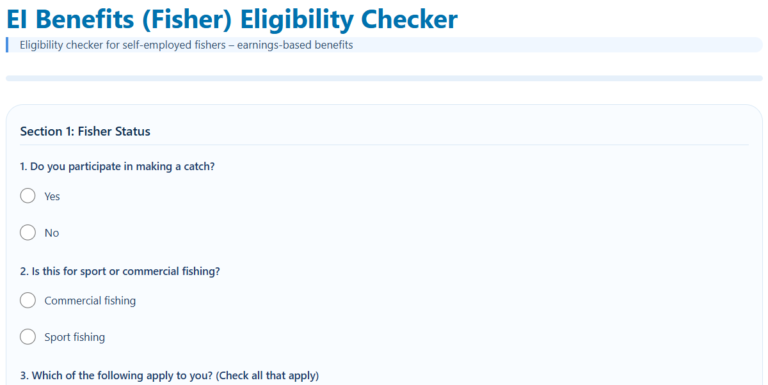
Since the commercial fishers do not have any records of insurable hours and punch cards, EI Fishing eligibility depends mainly on gross income from self-employment in fishing during the qualifying period. The exact EI fisher benefits amount calculation depends on the regional rate of unemployment where you live at present:
| Regional Rate of Unemployment | Minimum Fishing Earnings Required |
| 6.0% or less | $4,200 |
| 6.1% to 7.0% | $4,000 |
| 7.1% to 8.0% | $3,800 |
| 8.1% to 9.0% | $3,600 |
| 9.1% to 10.0% | $3,400 |
| 10.1% to 11.0% | $3,200 |
| 11.1% to 12.0% | $2,900 |
| 12.1% to 13.0% | $2,700 |
| 13.1% or more | $2,500 |
Earnings Threshold for Special Fishing Benefits
If you need to apply and claim for EI Fishing special benefits (for example: Sickness, Maternity, Parental, or Caregiving Benefits) instead of regular fishing benefits, you must have earned at least $3,760 from self-employment in fishing during your qualifying period. Here, your regional unemployment rates are not considered.
If you have past EI violations or formal written notices for misrepresentation, the minimum earnings required to establish a valid claim will be higher.
How are Weekly EI Fisher Benefit Payments calculated?
Service Canada calculates your weekly payment using your total qualifying earnings divided by a regional statutory divisor, which is tied to local unemployment figures.
How Service Canada Calculates Your EI Fishing Benefit
Fishing Earnings ÷ Regional Divisor = Weekly Insurable Fishing Earnings
+
Other Earnings ÷ Divisor or Weeks = Weekly Insurable Employment Earnings
=
Total Weekly Insurable Earnings
(Capped at the 2026 MIE weekly maximum of $1,325)
×
55% Benefit Rate
=
Final Weekly EI Fishing Benefit Rate
Statutory Regional Divisors used for EI Benefit Calculation
| Regional Rate of Unemployment | Minimum Divisor |
| 6.0% or less | 22 |
| 6.1% to 7.0% | 21 |
| 7.1% to 8.0% | 20 |
| 8.1% to 9.0% | 19 |
| 9.1% to 10.0% | 18 |
| 10.1% to 11.0% | 17 |
| 11.1% to 12.0% | 16 |
| 12.1% to 13.0% | 15 |
| 13.1% or more | 14 |
Examples: EI Fishing Benefits Calculation
Example 1: Pure Fishing Earnings
Johny fishes in an area where the unemployment rate is 11.5%, and the divisor will be 16 for this region. His total qualifying fishing income is $9,865.
- Calculate weekly earnings: $9,865 ÷ 16 weeks = $616.56/week
- Check the maximum limit: The 2026 weekly maximum is $1,325. Since $616.56 is below the limit, the full amount is used.
- Calculate the EI benefit: $616.56 × 55% = $339.11/week
Estimated EI Fishing Benefit: $339 per week before taxes.
Example 2: Combining Fishing with Other Employment
Simuta lives in an area where an unemployment rate of 8.8% is applied, and the divisor is 19.
- Weekly earnings from fishing: $24,800 ÷ 19 = $1,305.26/week
- Other insurable wages: $12,000 ÷ 19 = $631.58/week
- Combined weekly earnings: $1,305.26 + $631.58 = $1,936.84/week
- Apply the maximum: Since $1,936.84 is above the $1,325 weekly maximum, the calculation is capped at $1,325.
- Final EI benefit: $1,325 × 55% = $728.75/week ≈ $729/week
Estimated EI Fishing Benefit: $729 per week before taxes.
Low-Income Family Supplement & Tax Considerations
You will be eligible for the EI family supplement if:
- Your AFNI(Annual Net Family Income) is $25,921 or below
- You raise one or more dependent children
- You or your partner receive Canada Child Benefit (CCB)
- You qualify for the EI Family Supplement.
This helps boost your EI Fishing benefit rate from 55% up to 80% of average insurable earnings. It is important to know that only one spouse can collect the supplement at a time.
Are EI Fishing Benefits Taxable? Yes, it is taxable income. Federal and provincial or territorial taxes are automatically deducted from your bi-weekly payments.
Benefit Periods and Claim Durations
Eligible fishers can receive up to 26 weeks of regular fishing benefits within a scheduled window:
- Standard EI Fishing Benefits Window: The benefit window typically spans 37 weeks (minimum) to 38 weeks (maximum), during which you can take your 26 weeks of entitlements.
- EI Special Fishing Benefit Extensions: If you shift your fishing benefits to sickness, maternity, parental, or caregiving benefits, your benefit window can be extended up to a maximum of 52 weeks. It can be extended by 1 week for every week of special benefits received.
| Fishing Claim | Earliest Start | Latest End |
| Summer Fishing Claim | October 1 | June 15 |
| Winter Fishing Claim | April 1 | December 15 |
How to Apply for EI Fisher Benefits: Documents and Deadlines
You must submit your online EI Fisher benefits claim through the official Service Canada portal as soon as possible after completing your fishing activities. Before starting your online claim, collect the following details:
- Social Insurance Number (SIN)
- Date of birth proof
- Mother’s maiden name
- Home/mailing address
- Proof of immigration and work permit (if needed)
- Direct deposit bank account number
- Branch Code
- Buyers’ names and Addresses, and transaction dates for all buyers who purchased your catch over the qualifying period.
- Specific start and end dates for all self-employed fishing periods
- Secondary employment held during the previous 52 weeks
- Reasons for separation.
- Digital or Paper Records of Employment (ROEs)
Online Application Session Rules
- The online application for EI Fishing Benefits generally takes one hour.
- If you do not finish in one session, the system provides a temporary password.
- Your data is saved for 72 hours (3 days).
- If you do not submit the completed application within 72 hours, unsubmitted data is deleted for security purposes.
- Then you will be required to restart the claim application.
Track your seasonal catch receipts, calculate your regional divisor, and submit your online application fast within the 4-weeks to ensure you receive your full EI fishing benefits without disruptions.
Frequently Asked Questions
How is EI Fishing benefits eligibility determined based on insurable income instead of working hours?
Eligibility for EI Fishing Benefits requires gross fishing income between $2,500 and $4,200 during the qualifying period. It also depends on your regional unemployment rate, with zero minimum hours required.
How does “Regional Divisor” matter in weekly fishing benefits calculation?
Your total insurable fishing income is divided by a regional divisor. It ranges from 14 to 22 based on local unemployment to determine your average weekly insurable fishing income before taking the 55% benefit rate.
Can fishers get both Summer & Winter EI fishing benefits within a year?
Yes, fishers can avail two separate EI Fishing benefits claims per year. Summer EI Fishing Benefit claims are payable between October 1 and June 15, while Winter EI Fishing Benefit claims are payable between April 1 and December 15.
How are combined (Self-employed + salaried) EI Fishing Benefits calculated?
Self-employed fishing income is divided by the Regional Divisor. These are added directly to regular job income from the same 31-week window with the 55% rule.
How is “Working While on Claim (WWC)” calculated for active fishers?
You can keep 50% of EI for every dollar earned up to 90% of your previous weekly insurable earnings. Income above 90% is deducted $CAD for $CAD.
How is a fishing contractual crew-share arrangement verified?
Insurable fishing income is determined by your contractual crew-share percentage. Income is reported directly by the dedicated fish buyer or vessel master. It is required to provide an official Record of Employment (ROE).
Can self-employed fishers receive EI Special Benefits?
Yes, EI-enrolled self-employed fishers who pay regular EI premiums can claim sickness, maternity, parental, and caregiving benefits. This can extend the standard benefit window up to a maximum of 52 weeks.
Does EI Family Supplement increase fisher benefits for low-income fishing families?
Fishers raising dependent children whose net family income is $25,921 or less can receive the Family Supplement. This boosts their fishing benefit rate up to 80% of average insurable income.