
If you are giving birth to a child or going to adopt a child, this is really a major life event. In these situations, managing your family expenses and budget without working requires informed planning.
In Canada, the federal government’s Employment Insurance benefits program provides income support to growing families through EI Maternity and Parental Benefits. These benefits are provided to eligible working parents who contribute EI Premiums. These benefits are controlled and administered by Service Canada through the “Employment Insurance Act”.
Employment Insurance Maternity and Parental Benefits are a replacement of employment income when parents take necessary leave to care for their newborn or newly adopted child. These benefits are two separate benefit components with different rules, distinct eligibility, and different durations.
For new working parents, it is important to understand how EI Maternity and Parental Benefits work, how to choose the best option between standard and extended parental options, what sharing weeks between parents are, and how to calculate expected payouts.
This guide helps you to design a maternity and parental leave strategy that best fits your family’s personal and financial needs.
Table of Contents
2026 EI Maternity and Parental Benefits Rates
Employment Insurance benefit rates are dependent on the federal Maximum Yearly Insurable Earnings (MIE), which is indexed annually.
| 2026 EI Benefit Feature | Rate / Maximum | Duration / Requirement |
| Maximum Annual Insurable Earnings (MIE) | $68,900 | Annual limit |
| Maternity Benefits | 55% (up to $729 Per Week) | Up to 15 weeks |
| Standard Parental Benefits | 55% (Up to $729 Per Week) | Up to 40 weeks |
| Extended Parental Benefits | 33% (Up to $437 Per Week) | Up to 69 weeks |
| Qualifying Hours | 600 insurable hours | Within 52-week qualifying period |
Quebec Residents are eligible for maternity and parental EI benefits through the provincial program instead of federal Employment Insurance. It is also known as “Québec Parental Insurance Plan” or QPIP.
EI Maternity Benefit Rules and Eligibility
Thousands of mothers and parents wonder how to qualify for the Canada EI maternity and parental benefits in 2026. EI Maternity Benefits are designated for pregnant women or those who have recently given birth to a child. It is for those who want time to physically recover before and after delivery.
- Exclusivity of Maternity benefits: These benefits cannot be shared between parents or transferred to a non-birthing spouse or partner.
- This provides financial support to a new mother up to 15 weeks.
- This benefit covers 55% of average insurable weekly earnings (up to a maximum limit of $729 Per Week).
- Benefits can start as soon as 12 weeks before the expected delivery date and can be received up to 17 weeks after the birth date.
Special Circumstances
Surrogates and women whose pregnancy ends after the 19th week of pregnancy (due to miscarriage, termination, or stillbirth): These individuals also remain eligible for employment insurance maternity benefits.
EI Parental Benefits: Standard vs. Extended
Unlike EI maternity benefits, EI Parental benefits are available to both biological and adoptive parents. These are intended to provide financial assistance to those parents who care for a newborn or newly placed child. When applying for the parental benefits, you are required to choose between two different streams:
- EI Standard Parental Benefits
- EI Extended Parental Benefits.
Once parental benefits payments start, you can not switch the option. If two parents share employment insurance parental benefits, both must select the exact same type.
| Standard vs Extended EI Parental Benefits | ||
| Feature | Standard Option (12 Months) | Extended Option (18 Months) |
| Income Replacement | 55% Coverage of Income | 33% Coverage of Income |
| Maximum Weekly Benefit | $729 per week | $437 Per Week |
| One Parent | Up to 35 weeks | Up to 61 weeks |
| Shared Between Parents | Up to 40 weeks | Up to 69 weeks |
| Benefit Window | Within 52 weeks | Within 78 weeks |
Combined EI Maternity and Parental Benefits
Parents who give birth to a child frequently combine both types to maximize their continuous leave:
| Combination Strategy | Maternity Weeks | Parental Weeks (Single / Shared) | Total Combined Benefit Weeks |
| Maternity + Standard Parental | 15 weeks (55%) | 35 to 40 weeks (55%) | 50 to 55 weeks total |
| Maternity + Extended Parental | 15 weeks (55%) | 61 to 69 weeks (33%) | 76 to 84 weeks total |
How to Calculate EI Standard and Extended Leave Benefits?
Total gross income received under the standard and extended options over the full duration of leave is virtually identical if you earn at or above the insurable cap:
Standard Leave for Single Parent
15 weeks maternity × $729 + 35 weeks parental × $729
= $10,935 + $25,515 = $36,450
Extended Leave for Single Parents
15 weeks maternity × $729 + 61 weeks parental × $437
= $10,935 + $26,657 = $37,592
The extended option does not yield a large financial bonus; rather, it spreads roughly the same total benefit dollars across a longer 18-month timeline to give parents extended job-protected time at home.
Eligibility & Insurable Hours for Maternity and Parental EI Benefits
To apply for the EI Maternity and Parental Benefits in Canada, you must meet four major eligibility conditions:
- Interruption in Work and Earnings: Your normal weekly income must drop by more than 40% for one week.
- Earned Insurable Hours: You must have worked and accumulated at least 600 insurable hours in the last 52 weeks back to the start date of the EI Claim.
- Valid EI Contributions: You must have been paying Standard EI premiums. It has been deducted by your employer. If you are self-employed, the same EI contributions should be maintained for at least 12 months.
- Parental Status: You must be the biological, adoptive, or legal parent of the newborn or newly placed child.
EI-SUB Plans: Employer Top-Up Plans
Many Canadian workers and EI recipients offer maternity or parental salary top-ups through a Supplemental Unemployment Benefit (SUB) plan. Under an approved SUB plan:
- An employer increases your EI Benefits for Maternity and Parental Leave to a higher percentage of your regular salary. It can be boosted from 75% to 100%.
- As long as the SUB plan is registered and meets the guidelines of Service Canada, SUB Top-up payments are not deducted from your weekly EI benefit.
- Always check your employment contract or collective agreement to verify how top-ups are calculated under both standard and extended leave tracks.
Working with Maternity Parental Claim
Parents who want to work while receiving maternity and parental leave, whether it is occasional shifts, consulting work, or part-time assignments. These provisions can be applied while working on a claim:
- You can have 50% of your EI benefit for every dollar earned.
- This reduction can go up to 90% of your pre-claim average insurable weekly earnings.
- Over this 90% threshold, the benefit amount is deducted dollar-for-dollar.
- Income sources must be reported on your regular bi-weekly.
Apply Step-by-Step for Maternity and Parental EI Benefits
- You can apply for Canadian EI Maternity and Parental Benefits through the official website of Service Canada immediately after stopping work.
- It is always suggested not to wait more than 4 weeks after your last day of employment may result in lost entitlement.
- Usually, employers send online Records of Employment (ROEs) directly to Service Canada. You can verify that your ROE is on file by logging into your My Service Canada Account (MSCA).
- One-Week Waiting Period: There is a standard one-week unpaid benefits waiting period per claim. When parents share parental benefits, only one parent serves the waiting period.
Best Practices for Maximizing Claims
Successfully navigating the Employment Insurance Maternity and Parental Benefits in Canada comes down to careful coordination. Calculate your family budget and cash flow to know which option is suitable for you: the 12-month standard plan ($729 Per Week) or the 18-month extended option ($437 Per Week).
Ensure you have worked 600 insurable hours in advance. Check any employer top-up provisions. Submit your online application through Service Canada as soon as your leave begins. An instant application ensures you get the income replacement on time.
Frequently Asked Questions
How many insurable hours are required to qualify for EI maternity and Parental benefits?
You are required to secure at least 600 insurable hours worked in the last 52 consecutive weeks prior to application.
What is the maximum weekly payout for EI Maternity Benefits in 2026?
The benefit rate is 55% of your average insurable earnings, up to a maximum of $729 per week for up to 15 weeks.
What is the difference between Standard and Extended Parental Benefits?
Standard Parental Benefits offer a 55% rate (up to $729/week) for up to 40 shared weeks, while Extended Parental Benefits provide a 33% benefit rate (up to $437/week) for up to 69 shared weeks.
How does the CanadaCalculators.ca EI Maternity and Parental Benefits Eligibility Checker help?
It instantly calculates your worked hours, income record, and employment type to verify if you meet Service Canada’s eligibility criteria.
What can I calculate using the CanadaCalculators.ca EI tool?
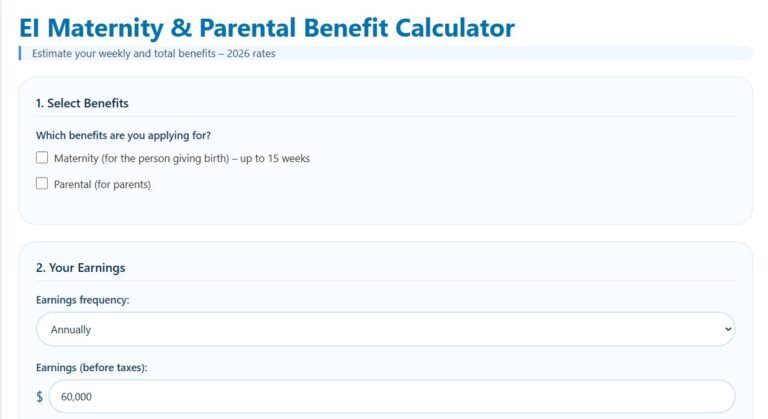
You can calculate your weekly EI Maternity and Parental Benefits payment, total entitlement, and choose the perfect option between Standard and Extended parental leave.
Can both parents share EI parental benefits weeks?
Yes, parents can share the weeks concurrently or consecutively, gaining access to extra bonus weeks when shared.
Are self-employed individuals eligible for EI maternity & parental benefits?
Yes, they can access the EI special benefits program at least 12 months prior and meet minimum net earnings thresholds.
When can EI maternity benefits start?
EI Maternity leave can start up to 12 weeks before the expected due date or the actual week of birth of the child.
Are EI Maternity and Parental benefits taxable?
Yes, EI maternity and parental benefit payments are considered taxable income.
How long does it take to receive the first Employment Insurance Maternity and Parental benefit payment?
Benefits are processed within 28 days after successful submission of the application and Record of Employment (ROE).