If you have ever stared at your pay stub and felt a little dizzy, you are not alone. The big question almost every working Albertan asks at some point is: how much income tax in Alberta am I actually paying? The answer changes depending on whether you work for an employer, run your own business, or fall somewhere in between. Understanding how much income tax in Alberta you owe is not just about being curious. It is about knowing exactly what hits your bank account every payday. In this guide, I will break down the 2026 tax brackets, compare employees versus self-employed, and show you exactly where your money goes.
Table of Contents
How Much Income Tax in Alberta for 2026?
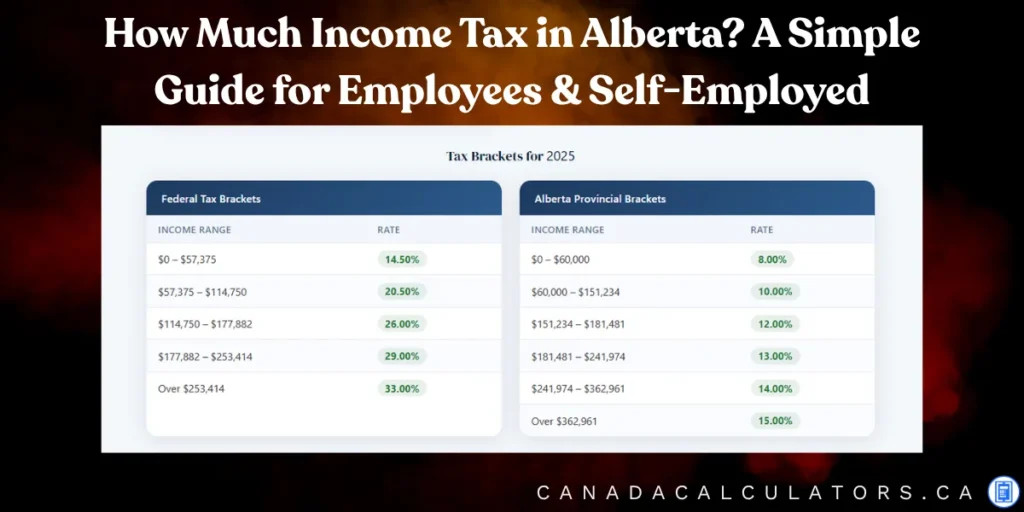
Let us break down the main question right away—how much income tax in Alberta do you pay? Alberta has a unique tax structure compared to other provinces like Ontario or BC. Starting in 2025 and continuing into 2026, Alberta uses a hybrid system with four brackets:
| Tax Rate | Income Range |
| 8% | Up to $61,200 |
| 10% | $61,200 – $154,259 |
| 12% | $154,259 – $185,111 |
| 13% | $185,111 – $246,813 |
| 14% | $246,813 – $370,220 |
| 15% | Above $370,220 |
So, how much income tax in Alberta you pay depends entirely on which bracket your salary falls into. But remember, this is only the provincial part. You still owe federal tax on top of that.
Federal Tax: The Other Part of Tax Calculation
When people ask how much income tax in Alberta, they usually mean the total combined tax. The federal government takes its share first. For 2026, federal rates are:
| Tax Rate | Income Range |
| 15% | Up to $58,523 |
| 20.5% | $58,523 – $117,045 |
| 26% | $117,045 – $181,440 |
| 29% | $181,440 – $258,482 |
| 33% | Above $258,482 |
To really understand how much income tax in Alberta you will pay, add your provincial rate to your federal rate for each portion of your income. For most middle-class Albertans, the combined marginal rate lands between 25% and 35%.
Alberta Take Home Pay After Tax: Get Real Numbers
Alberta take home pay after tax actually matters for your daily life. If you earn $60,000 per year, here is what your Alberta take-home pay after tax looks like, approximately:
| Component | Approximate Amount |
| Provincial Tax | ~$4,900 |
| Federal Tax | ~$7,200 |
| CPP | ~$3,400 |
| EI | ~$1,000 |
- That leaves your Alberta take-home pay after tax at around $43,500 annually, or about $3,625 per month.
- That number changes as your income rises.
- For someone earning $100,000, your Alberta take-home pay after tax drops to roughly $72,000 after all deductions.
Alberta Income Tax Percentage by Salary
Your Alberta income tax percentage by salary is not a single number. It is a marginal rate. That means different dollars get taxed at different percentages. Here is your Alberta income tax percentage by salary, broken down simply:
| Salary | Alberta Tax Breakdown |
| $50,000 | 8% (entire income in the lowest bracket) |
| $80,000 | 8% on the first $61,200, 10% on the remaining income |
| $160,000 | 8% + 10% + 12% (12% applies above $154,259) |
Knowing your Alberta income tax percentage by salary helps you plan for raises, bonuses, or freelance work. A $5,000 bonus might be taxed at your highest marginal rate, not your average rate.
Alberta Tax Deductions from Paycheck
If you are an employee, you have likely noticed Alberta tax deductions from your paycheck happen automatically. Your employer uses the CRA payroll tables to calculate:
- Federal tax
- Provincial tax (which answers how much income tax in Alberta)
- CPP contributions
- EI premiums
These Alberta tax deductions from your paycheck mean you rarely owe extra money at tax time. However, if you have multiple jobs or side income, your Alberta tax deductions from paycheck might be too low because each employer assumes that job is your only income.
Self-employed people have no Alberta tax deductions from their paycheck at all. You must calculate and remit your own taxes quarterly to the CRA.
Example: How Much Tax on 80000 in Alberta?
This is one of the most common questions. Let me give you a clear answer on how much tax on 80000 in Alberta for 2026. If you earn $80,000 exactly:
| Income Portion | Provincial Tax | Federal Tax | Combined Rate |
| First $61,200 | 8% | 15% | 23% |
| Remaining $18,800 | 10% | 15% | 25% |
So, how much tax on 80000 in Alberta works out to approximately:
| Component | Approximate Amount |
| Provincial Tax | ~$6,500 |
| Federal Tax | ~$12,000 |
| Total Income Tax | ~$18,500 |
That means how much tax on 80000 in Alberta leaves you with roughly $61,500 in your pocket before CPP and EI. After CPP and EI, your take-home is around $57,000.
Employees vs. Self-Employed: A Huge Difference
How much income tax in Alberta you pay is the same regardless of employment status. The difference is when and how you pay it.
| Category | Employees | Self-Employed |
| Tax Deduction | Taxes are deducted automatically | No automatic deductions |
| Tax Planning | No surprises at tax time | Must save 25–30% of every invoice |
| CPP Contribution | Employer pays half your CPP | You pay full CPP (11.9%) |
So while the amount of income tax in Alberta is identical for an employee and a self-employed person earning the same amount, the self-employed person feels it more because they also pay the employer portion of CPP.
Alberta Effective Tax Rate Calculator: The Smart Way To Estimate
Trying to calculate all of this manually is a headache. The brackets change. CPP and EI limits change. Personal amounts change every year. That is why the smartest move is to use an Alberta effective tax rate calculator.
An Alberta effective tax rate calculator does something simple but powerful. It takes your gross salary, subtracts the basic personal amounts, applies the correct marginal rates, and tells you your actual average tax rate—not just the theoretical one.
For example, a good Alberta effective tax rate calculator will show you that an $80,000 earner has an effective tax rate of roughly 18–19%, even though their marginal rate is 25%. That gap is important for budgeting.
We strongly recommend using the canadacalculators.ca Alberta Income Tax Calculator for 2025 & 2026. It is updated for 2026 tax brackets, handles CPP2 and EI changes, and works for both employees and the self-employed. You can plug in your salary, add RRSP contributions, and see your exact Alberta take-home pay after tax in under a minute.
Asking how much income tax in Alberta is not a one-time question. Every raise, every side gig, every new tax year changes the answer. The good news is that Alberta remains the lowest-tax province in Canada for most earners. The bad news is that “lowest” still means thousands of dollars leaving your pocket.
Whether you are an employee watching Alberta tax deductions from your paycheck every two weeks, or a freelancer trying to save for April, the same rule applies: do not guess. Use the Alberta Income Tax Calculator to get your real numbers. It is free, accurate, and saves you from doing messy math by hand.
Frequently Asked Questions
1. How much income tax in Alberta do I pay if I earn less than $22,323?
Zero provincial income tax.
2. Does Alberta take-home pay after tax change with a side hustle?
Yes. No tax is deducted from side income, so you must save 25–30% yourself.
3. What is my Alberta income tax percentage by salary on $80,000?
Marginal rate: 25% (10% provincial + 15% federal). Effective rate: ~18%.
4. Why do my Alberta tax deductions from paycheck differ from a coworker’s?
Different TD1AB forms. More tax credits = less tax deducted.
5. How much tax on 80000 in Alberta with a $5,000 RRSP contribution?
About $1,200 less tax. You are taxed as if you earned $75,000.