
Are you a disabled resident of Ontario and navigating monthly expenses? It requires financial predictability, especially for Ontario PwDs who rely on government support like ODSP Payments. The Ontario Disability Support Program is a one-of-a-kind social assistance or income support program that is aimed at helping disabled residents.
It helps cover shelter/house rent, food/grocery, and daily essentials like household items, clothes, travel expenses, and other expenses. It is important because late deposits of benefit payments can cause bank charges or delayed rent; tracking every scheduled ODSP payment is vital for effective household budgeting.
According to the Ontario provincial guidelines, an ODSP payment is basically distributed on the final business day of each month. When the payment date coincides with any holiday, the payment deposit is shifted to the closest preceding working day.
This article explains all the important facts and information about the Ontario Disability Support Program that every recipient must know, including payment dates, eligibility, exemptions, special supplement payments, and employment rules.
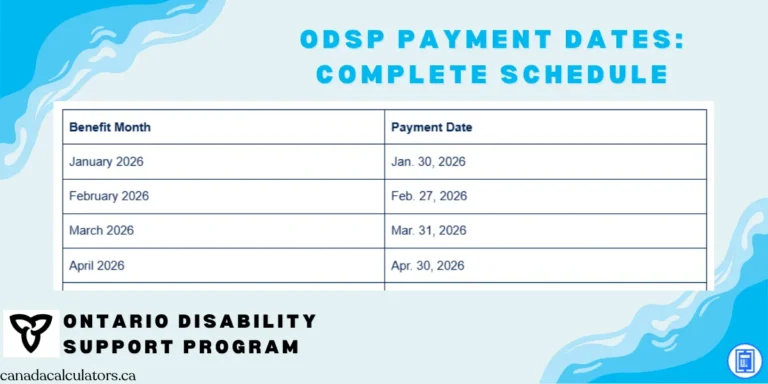
2026 ODSP Payment Dates: Complete Schedule
Here is the full monthly schedule for ODSP payment dates across 2026:
| Benefit Month | ODSP Payment Deposit Date | Notes / Adjustments |
| January 2026 | January 30, 2026 | Last business day of the month |
| February 2026 | February 27, 2026 | Last business day of the month |
| March 2026 | March 31, 2026 | Standard end-of-month transfer |
| April 2026 | April 30, 2026 | Standard end-of-month transfer |
| May 2026 | May 29, 2026 | Adjusted for weekend |
| June 2026 | June 30, 2026 | Standard end-of-month transfer |
| July 2026 | July 31, 2026 | First payment featuring the 1.9% rate increase |
| August 2026 | August 31, 2026 | Standard end-of-month transfer |
| September 2026 | September 29, 2026 | Adjusted for preceding business day |
| October 2026 | October 30, 2026 | Last business day of the month |
| November 2026 | November 30, 2026 | Standard end-of-month transfer |
| December 2026 | Mid-to-Late December (TBC) | Accelerated release for holiday season |
If you want to receive your ODSP payment on time, use an updated bank account and electronic/direct deposit payment method set up with your caseworker.
Payment Delivery Methods for Your ODSP Payments
Ontario Disability Support Program is operated and funded by the Ministry of Children, Community and Social Services and the Ontario provincial government. ODSP Assistance Payments are issued on certain payment dates through three distinct disbursement channels:
- Direct Bank Deposit (DBD): This is the best method to transfer the benefits. The standard and fastest distribution method. Funds are transferred directly into a savings account early on the scheduled ODSP payment morning.
- Reloadable Payment Card (RPC): For Ontario Disability Recipients without traditional banking access, the province provides a prepaid card. Every monthly ODSP payment is loaded online. This allows point-of-sale debit purchases, online transactions, and cash withdrawals at ATMs.
- Paper Cheques: Ontario Disability Support Payments are also issued by Paper cheques. Cheques are sent under strictly approved hardship exemptions approved by the program director.
Paper Cheque Exceptions
To qualify for physical paper cheque delivery of ODSP Payments, PwD individuals must demonstrate specific geographic or physical barriers:
- Who can not visit an ATM or local bank branch within a reasonable travel distance.
- Living in a remote community or First Nations reserve without direct online banking connectivity.
- Living with severe physical or cognitive disabilities that prevent debit card operation.
- Those who are not able to provide standard identity documents needed by banks.
- Living in areas or group homes where individual online or digital banking services are not available.
ODSP Current Payment Rates & Adjustments
Since September 2022, the Ontario government has permanently increased and adjusted the disability support payment rates in effect in line with the provincial Consumer Price Index (CPI). It was done to help offset inflation. Payments are reviewed and adjusted regularly on an annual basis every July:
| Effective Date | Increase | Significant Changes | Impact on Benefits |
| September 2022 | 5.0% | Ontario increased the Support rates by 5.0% as a first major enhancement after several years. | Immediate relief to recipients and raised monthly assistance levels. |
| July 2023 | 6.5% | Benefits were adjusted to inflation for the first time, resulting in a 6.5% increase. | Protected purchasing power during a period of high inflation. |
| July 2024 | 4.5% | Inflation indexing or adjustment with a 4.5% increase rate based on CPI Updates. | Further increased monthly payments and maintained the real value of benefits. |
| July 2025 | 2.8% | A 2.8% cost-of-living adjustment (COLA) increase was applied. Raising the maximum baseline payment for single up to $1,408/month. | Continued annual indexing while boosting the maximum monthly payment available. |
| July 2026 | 1.9% | Ontario government implemented another 1.9% inflation adjustment, extending its commitment to annual benefit indexing. | Total benefit growth since indexing began exceeded 22%, significantly improving long-term financial support for recipients. |
Payment Structure for Ontario Disability Monthly Support
Every baseline maximum ODSP payment consists of two foundational funding pillars: Basic Needs and Shelter Allowance.
- ODSP Basic Needs Allowance: It is intended for food, clothing, personal care items, and day-to-day household operations.
- ODSP Shelter Allowance: This is calculated based on actual housing expenditures up to established policy caps. This part covers home rent, mortgage payments, property taxes, utilities, and home insurance.
| Recipient Category | Basic Needs Max | Shelter Allowance Max | Maximum Total Base Benefit |
| Single Individual | $809 | $599 | $1,408 (plus 2026 CPI index) |
| Couple (One Partner Eligible) | $1,166 | $941 | $2,107 (plus 2026 CPI index) |
| Single Parent (1 Child) | $952 | $941 | $1,893 (plus 2026 CPI index) |
July 2026 ODSP Rates
In July 2026, it has been increased by 1.9%, which applies across basic needs, maximum shelter caps, board and lodging allowances, double-disability couple rates, and specialized residential care funding.
Supplementary Health Benefits Along with ODSP
Alongside the monthly disability support payments, extended health coverage is also unlocked. These health supplement benefits would otherwise represent major out-of-pocket expenses:
- Prescription Drugs & Dental Care: This offers full coverage of prescribed medicines and dental treatments. Eligible prescription medications and baseline dental procedures are allowed.
- Eye/Vision & Hearing Aid Support: This supplement covers eye tests, prescription eyewear, and hearing aid fittings or maintenance.
- Special Diet Allowance with ODSP: Additional funding can be received up to $250 monthly depending on medical diagnosis for approved health conditions requiring specialized nutrition.
- Medical Travel Assistance: ODSP Recipients can get reimbursement for travel, taxi, or travel costs related to frequent medical appointments.
- Assistive Devices Program (ADP) Co-pay: Financial help covering mobility aids, orthotics, prosthetics, and device repairs.
Working While On ODSP & Combined Benefits
Working while being on ODSP payment offers significant financial advantages due to generous flat-rate earnings rules:
| ODSP Employment Rule | How It Works | Benefit to Recipients |
| $1,000 Monthly Earnings Exemption | You can earn up to $1,000 in net employment income each month without any reduction to your ODSP Support Payment. | Promotes employment while allowing recipients to keep both their full wages and full ODSP benefits. |
| 75% Partial Deduction | Net earnings more than $1,000 are reduced at a rate of 75%. This means you keep 25% of income or 25 cents on each dollar earned. | Ensures working always increases your total monthly income, even after the exemption limit is exceeded. |
| $100 Work-Related Benefit | Eligible ODSP recipients who are employed receive an additional $100 per month to help cover work-related expenses. | Assists with costs such as transportation, uniforms, tools, or other job-related expenses, making employment more affordable. |
Canada Disability Benefit (CDB): Federal CDB payments (up to $200 monthly) are classified as fully exempt income by Ontario social assistance, ensuring recipients receive both federal and provincial grants without clawbacks.
Key ODSP Eligibility Factors and Needed Documents
To qualify for an ODSP payment, applicants must meet clear financial and medical requirements given below:
- Applicant must be at least 18 years old and a legal resident of Ontario.
- Application must demonstrate financial need based on household asset limits and low income.
- Possess a verifiable physical or mental impairment expected to last at least 12 months that restricts daily functioning.
Required Documentation for ODSP Disability Support
When submitting an application online or through a local caseworker, assemble the following records for timely ODSP Payment with easy approval:
- Social Insurance Numbers (SIN)
- OHIP cards for all family members.
- Official proof of age
- Legal proof of living in Ontario
- Birth Certificate or Canadian immigration documents
- Detailed bank statements covering previous 12 months
- Housing Expense Proof
- Lease Agreements
- Rent Receipts
- Utility Bill or copies
- Comprehensive tax filings
- Notice of Assessment
- Proof of external assets
Staying informed about your official ODSP payment schedule, payment methods, and payment structure ensures you maintain financial stability, avoiding unnecessary penalties. It also helps maximize your supplement payments and all health and housing supports guaranteed under Ontario law.
Frequently Asked Questions
What is the difference between $100,000 limit non-discretionary trust and an absolute discretionary trust (Henson Trust)?
Capital in a standard non-discretionary trust or life insurance policy is exempt up to $100,000. An absolute discretionary trust (Henson Trust) where the beneficiary has no legal claim to demand funds has no upper asset limit and is fully exempt.
What is the compensation limit for personal injury under ODSP?
Up to $100,000 in pain and suffering compensation is allowed. It is $50,000 lower than under Ontario Works.
How is the $84 Guide Dog Benefit claimed?
Recipients who depend on ODSP can claim a flat $84 per month per dog to cover the regular veterinary and food care costs. They are required to submit proof of certification.
Does Canada Pension Plan Disability Benefits affect the ODSP payment?
Unlike employment income, CPP-D is listed as non-working income, and it is deducted dollar-for-dollar from your monthly ODSP entitlement. ODSP serves as a top-up if your CPPD is lower than your maximum ODSP amount.
Is the second vehicle included in ODPS Assets?
While your primary vehicle is fully exempt (any value), a second vehicle is exempt up to $15,000 in value. It must be required for an adult family member for employment or medical treatment purposes.
How does a Medical Review Date (MRD) work? Who is classified as “Review Not Required”?
The Disability Adjudication Unit (DAU) assigns a Medical Review Date (MRD) usually within one to five years, in case your condition is about to improve. If your disability is likely permanent and irreversible, you are assigned a “No Review Required” status.
What is the ODSP Rapid Reinstatement rule if someone quits?
If someone quits the ODSP benefits because of exceeding the income threshold and you later lose your job or cannot work, you can be reinstated at any time in the future without having to repeat the Disability Determination Package (DDP) medical review.
How are segregated funds and locked-in life insurance Cash Surrender Values (CSV) treated?
These are treated as exempt assets up to a maximum value of $100,000 per benefit unit.
What is the difference between ODSP EHB and THB?
Extended Health Benefit covers ongoing drug, dental, and medical equipment coverage if high recurring disability-related health expenses are more than your income. Transitional Health Benefit covers prescription drugs and dental for up to 12 months. When someone quits ODSP for employment with comparable private health benefits pending.