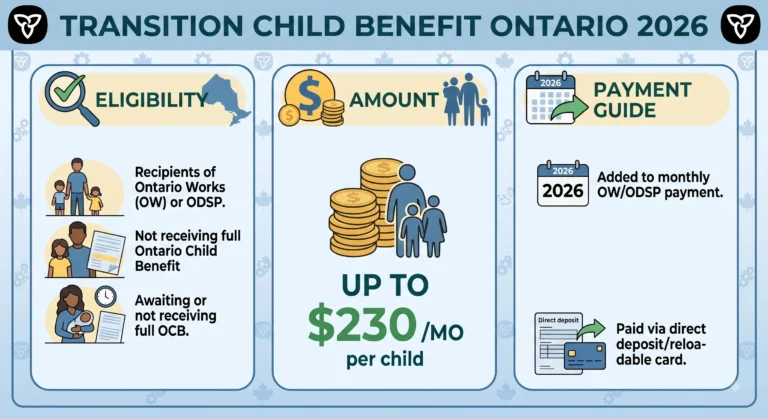

Knowing and understanding how different provincial and federal benefits impact Ontario residents who apply for social assistance programs. Transition Child Benefit is available for low-income residents who are depending on OW and ODSP Support. Among these supports, the Transition Child Benefit (TCB) works as an important financial bridge.
TCBs are designed for recipient families, disabled people, and job-loss workers on Ontario Works or Ontario Disability Support Program. This benefit ensures that low-income households do not face severe income shortfalls while waiting for monthly tax-administered child benefits to be processed.
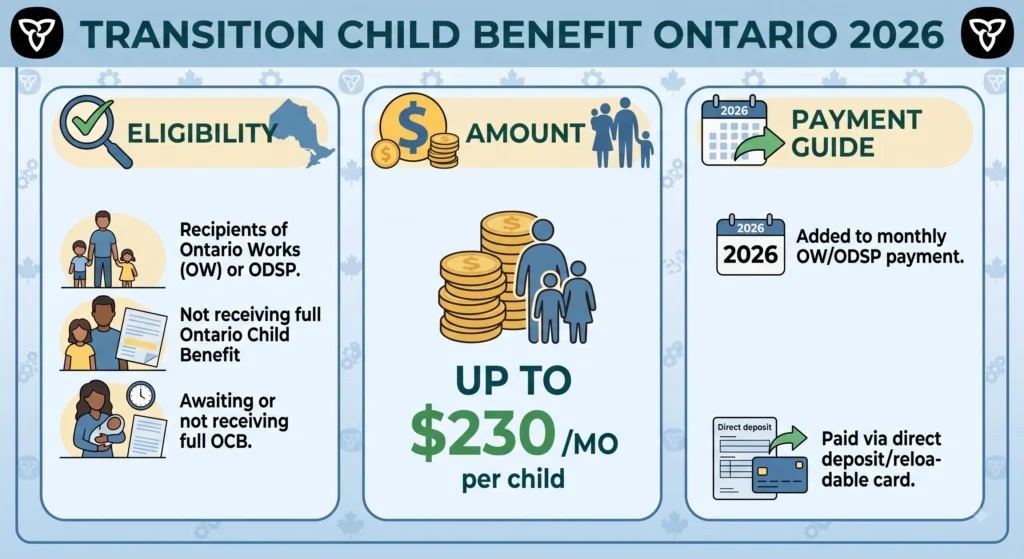
Table of Contents
What is the Transition Child Benefit?
Transition Child Benefit is also an additional monthly support, like other benefits dedicated to children. It is provided by the MCCSS. It is aimed at parents and guardians receiving OW or ODSP. It is for those who are receiving neither any child benefits (federal and provincial) nor less than the maximum allowable amount. Child benefits in Ontario are primarily divided into two main streams:
| Benefit | Maximum Amount | Eligibility / Income Facts | Purpose | Payment |
| CCB | $7,997/year per child under 6; $6,748/year per child aged 6–17 | Based on AFNI, No. of children, age of child | Cost of raise support | Tax-free monthly |
| OCB | Up to $143/month per child or $1,716/year | Low- and mid-income range ON families | Additional support for children | Paid monthly with the CCB |
Both depend on annual income tax filings and CRA timelines; delays can occur when establishing eligibility. After the birth of a newborn, a change in immigration status, or late tax submissions. The Transition Child Benefit exists to cover that gap so children do not go without basic necessities.
TCB(Transition Child Benefit) Key Eligibility Criteria
To qualify for the ON Transition Child Benefit, a household must meet specific criteria and social assistance status:
- Active Support Status: The main applicant must be actively receiving monthly support through either Ontario Works (OW) or Ontario Disability Support Program (ODSP).
- Dependent Children Under 18: The family must have dependent children under the age of 18 accommodated with the main TCB applicant.
- Child Benefit Gaps or Reductions: The family must meet one of these three situations:
- Do Not Receive Ontario Child Benefit or Canada Child Benefit Yet.
- Do Not Receive less than the maximum monthly amount for any of their dependent children.
- Actively waiting for their regular expected monthly OCB payments.
How to Access the Transition Child Benefit
Transition Child Benefit does not require a separate application form. This is the most practical aspect of TCB. When you maintain an active file with OW or ODSP income support, your eligibility is automatically verified by your assigned caseworker based on the household information you provide.
Key Tips: How to Ensure Transition Child Benefit
- Report Changes Immediately: If there are changes in your family, such as the birth, adoption, or custody arrangements, it is your duty to update it to your caseworker.
- Demonstrate Active Effort: To maintain eligibility for the TCB, applicants must demonstrate that they are actively trying (or have tried) to apply for and receive the Ontario Child Benefit and Canada Child Benefit.
- File Income Taxes Annually: Since the CRA assesses OCB & CCB eligibility based on tax returns. Both parents/guardians must file their annual income tax returns (even on zero income)
Your caseworker may request proof of your tax filings or confirmation letters from the CRA showing that your application for federal/provincial child benefits is currently under review.
Understand how the TCB Adjustment Works
There is a common point of confusion for support and the recipients cosider that what happens when delayed OCB and CCB payments are finally issued. Understanding the process prevents unexpected changes to your monthly income.
- Waiting Period: While you wait for CRA processing, the provincial government pays you the monthly Transition Child Benefit through your OW or ODSP payment.
- Retroactive Lump-Sum: Once the CRA approves your OCB/CCB application, they typically start your retroactive/lump-sum payment to cover all the backdated months you waited and did not receive benefits.
- Offset Adjustments: Because the TCB was paid to cover those exact same months, the government will make an adjustment to your subsequent OW or ODSP payments to recover the duplicated amount. This ensures families do not receive double payments for the same calendar period.
Your caseworker reviews the exact retroactive amounts received from the CRA and explains how any monthly adjustments will be applied to your assistance file.
How to Maintain Continuous Coverage
- Save all the Receipts and Documents: Take care to keep all the documents and reports from the CRA regarding your Canada Child Benefit or Ontario Child Benefit applications.
- Maintain Proper Communication: Tell your OW or ODSP assistance help caseworker as soon as you receive any lump-sum payments or letters updating your OCB status.
- Caseworker Helps & Guide: If you are not sure why your amount changed, or any lower payment or a payment freeze, schedule a file review with your caseworker. This helps you to go over the provincial directives.
Keep income tax files updated and maintain clear reporting of changes in income and family size with your caseworker. Eligible families can effectively use the Transition Child Benefit to maintain household budget stability throughout any administrative transitions.
Frequently Asked Questions
What is the fixed monthly maximum Transition Child Benefit (TCB) rate in 2026?
The TCB provides up to a monthly maximum of $230 per child for Ontario Works Recipients and up to $207 per child for ODSP recipients.
How is partial TCB calculated for Ontario Child Benefit recipients?
The monthly TCB formula for OCB Recipients:
Transition Child Benefit = (Maximum TCB x Number of Dependent Children Below 18) – (Actual OCB Received)
Actual OCB = Monthly OCB (Ontario Child Benefits) + Monthly NCBS (National Child Benefit Supplement)
What are the conditions for a four-month TCB time limit extension?
According to ODSP Rules, the caseworker can extend Transition Child Benefits beyond 4 months if the recipient’s CRA OCB/NCBS benefits are delayed and they make efforts to resolve the delays.
How are TCB funds recovered once CRA issues a retroactive lump-sum CCB/OCB payment?
The overpayment is recovered by reducing your monthly OCB/CCB for a maximum of 3 consecutive months or until repaid in full.
How much TCB is given in case of shared 50-50 custody?
Parents with 50-50 custody of children can receive 50% of the monthly TCB amount ($115 per child per month).
Can my family receive TCB if the current tax return has been filed but not assessed?
In this situation, TCB will automatically bridge the difference until your assessment is completed.
Does a newborn child affect TCB eligibility?
Yes, while parents wait for registration of birth and CRA child benefits are processed, TCB can be started from the birth month.
Is a separate application required for the TCB (Transition Child Benefit) for OCB Applicants?
No, the caseworker automatically activates the TCB once the OCB delay is confirmed.





Pingback: How to Maximize Your Ontario Works Basic Needs Allowance in 2026 - Canada Calculators Blog