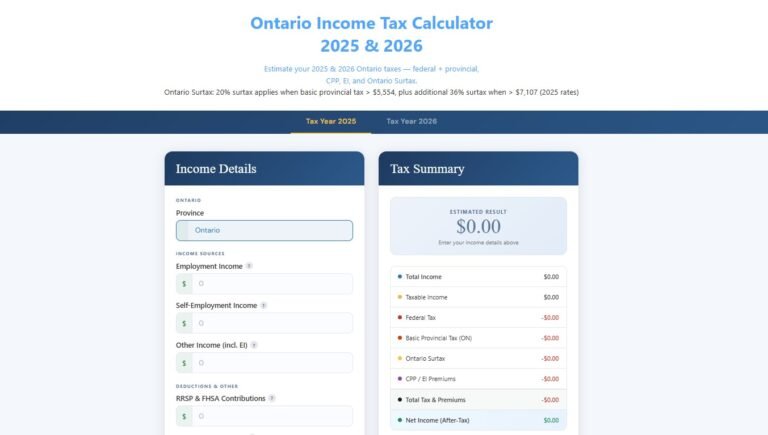

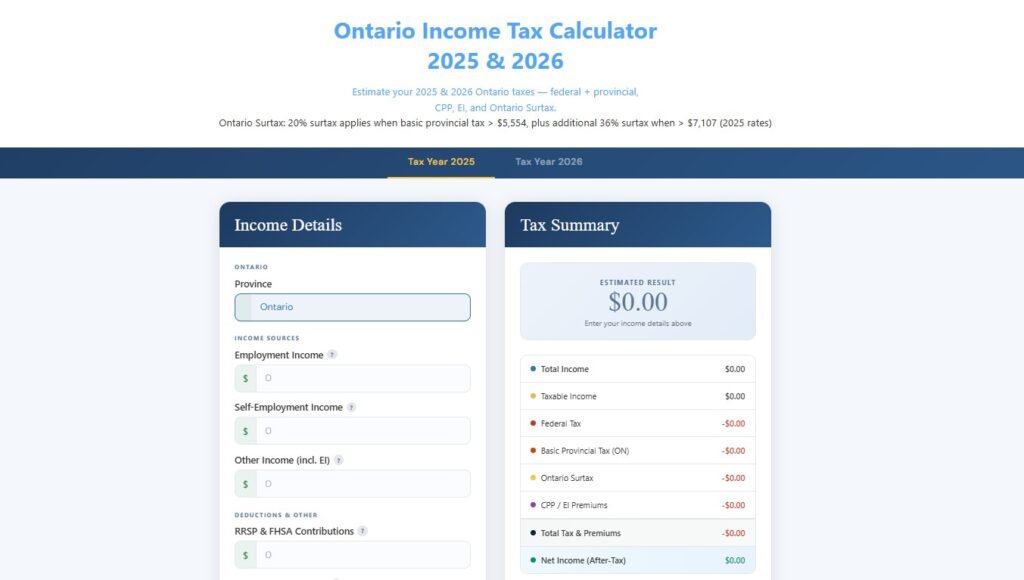
Making a personal budget and understanding income taxes in Ontario needs proper understanding of Ontario Income Tax bracket rates and federal & provincial Tax systems. Ontario Income Tax Owe Calculator 2026 helps estimate income tax owed and understand the tax system by applying necessary contributions.
Beyond standard and marginal income tax rates, Ontario applies provincial surtaxes and a dedicated health premium. These help reduce the tax owed in ON. Determining your net take-home pay in Ontario involves considering provincial calculations alongside federal taxes and statutory payroll contributions.
An Ontario income tax owe calculator 2026 simplifies this process by integrating every statutory layer to deliver an accurate estimate of your annual tax bill. This article includes steps to calculate Ontario Income tax liabilities, reduction factors, example calculations, and federal and marginal ON income tax brackets.
Table of Contents
Why Ontario Tax Calculations Are Unique
Most provinces of Canada determine personal income tax through a simple progressive and increasing bracket system. Ontario, however, depends on a 3-tier provincial model:
- Basic Provincial Tax: Progressive tax rates are applicable across the five fixed and certain income tiers.
- Surtaxes in Ontario: An additional “tax on tax” system is applied in Ontario when your basic provincial tax crosses the specific limit.
- Ontario Health Insurance Premium (OHIP): A mandatory annual fee determined by your taxable earnings.
Ontario surtaxes (Taxes-on-Tax) are estimated based on the tax amount rather than taxable income itself. Higher-income individuals need to pay tax at higher effective marginal rates. An Ontario income tax owe calculator 2026 automatically applies this multi-model formula to prevent manual errors.
Ontario Provincial Tax Brackets and Rates for 2026
For 2026, the Ontario Ministry of Finance has adjusted the basic provincial tax limits to consider inflation:
| Taxable Income Bracket | Basic Ontario Tax Rate |
| Up to $53,891 | 5.05% |
| $53,891.01 to $107,785 | 9.15% |
| $107,785.01 to $150,000 | 11.16% |
| $150,000.01 to $220,000 | 12.16% |
| Over $220,000 | 13.16% |
Residents of Ontario are also eligible for the Ontario Basic Personal Amount (BPA), which provides a non-refundable tax credit that protects the lowest bracket of income from provincial tax.
Understanding the Ontario Surtax and Health Insurance Premium
The provincial surtax and health premium significantly increase the final amount you owe the Canada Revenue Agency (CRA):
- The 20% Surtax Tier is applied to Ontario basic tax over $5,818.
- The 36% Surtax Tier is applied to Ontario basic tax over $7,446 (in addition to the 20% surtax).
Ontario Health Premium
| Taxable Income | OHP Amount |
| Under $20,000 | $0 |
| 20,000–200,600 | Varies based on income |
| Over $200,600 | Maximum $900 |
Combined with federal brackets, these extra liabilities push Ontario’s top combined marginal tax rate on employment income to 53.53% for income over $258,482.
Federal Tax Rates for Ontario Residents in 2026
In addition to provincial obligations, Ontario taxpayers pay federal income tax to the CRA. The 2026 federal brackets are structured as follows:
| Income Range | Tax Rate |
| Up to $58,523 | 14.0% |
| $58,523.01 – $117,045 | 20.5% |
| $117,045.01 – $181,440 | 26.0% |
| $181,440.01 – $258,482 | 29.0% |
| Over $258,482 | 33.0% |
When calculating the total tax liabilities, an Ontario income tax owe calculator 2026 applies the federal and provincial tax rates, surtaxes, and non-refundable credits into a single combined figures.
Example for Ontario Income Tax Calculation: $95,000 Salary
To understand how these rules work together, consider an Ontario resident working as a full-time employee earning a gross annual salary of $95,000:
Provincial Tax & Surtax Computation
- Calculation of Base Provincial Tax
(5.05% on first $53,891) + (9.15% on remaining $41,109) = $2,721.50 + $3,761.47 = $6,482.97
- Subtract Provincial Basic Personal Amount Credit from Base tax: Approx. $640
- Net Base Ontario Tax: 6482.97 — $640 = ~$5,843
- Ontario Surtax: 20% on tax exceeding $5,818 = ~$5.00
- Ontario Health Premium: ~$750
- Total Provincial Liability: ~$6,598
Federal Tax Calculation
- Calculation of Base Federal Tax
(14% on first $58,523) + (20.5% on remaining $36,477) = $8,193.22 + $7,477.79 = $15,671.01
- Subtract Federal Basic Personal Amount/Credit from Base Tax: ~$2,303
- Total Federal Liability: ~$13,368
Mandatory Statutory Deductions
- Canada Pension Plan (CPP & CPP2) + Employment Insurance (EI): $4,250 + $1,050 = $5,300
- Provincial + Federal Total Income Tax: $19,966
- Estimated Net Annual Take-Home: ~$69,734 (approx. $5,811/month)
Using an Ontario income tax owe calculator 2026 at CanadaCalculators.ca applies employee’s marginal tax rate on their next dollar earned is 31.48% (20.5% federal + 9.15% base provincial + 1.83% surtax). their effective (average) total income tax rate sits at approximately 21.0%.
Employees vs. Independent Tax Owe in Ontario
Employment classification changes the timing of tax payments and the total burden of statutory deductions:
| T4 Salaried Employee | Self-Employed / Freelancer |
| Employer deducts income tax from each month’s salary | Responsible for setting aside and paying taxes |
| Employer covers its share of CPP contributions | Pays both the employee and employer portions of CPP |
| Typically covered under EI through payroll | EI coverage may differ depending on circumstances |
| Receives relatively consistent take-home pay | Income can vary based on clients and business activity |
| Fewer business-related deductions to manage | Can claim eligible business expenses |
| Annual tax filing is generally simple | May need to make CRA instalment payments during the year |
For self-employed people, an Ontario income tax owe calculator 2026 helps estimate the CPP/CPP2 contribution liabilities and models allowable business expense write-offs against gross receipts.
How to Reduce Your Ontario Tax Owe Burden
Several federal and provincial mechanisms can help lower taxable income and reduce the impact of higher brackets and surtaxes:
- Registered Retirement Savings Plan: RRSP Contributions help decrease the taxed income directly. For someone who comes under the 43.41% marginal bracket ($117,046 to $150,000), a $10,000 RRSP contribution ensures tax savings of approx. $4,341.
- First Home Savings Account: FHSA provides up to $8,000 annual in tax-deductible contributions to eligible first-time homebuyers. It combines the tax deduction of an RRSP with the tax-free withdrawals of a TFSA.
- Low-Income Individuals and Families Tax Credit: Eligible low-income workers in Ontario can claim a non-refundable provincial tax credit of up to $875 to eliminate or reduce basic provincial income tax.
- Ontario Trillium Benefit: OTB combines the Ontario Sales Tax Credit, Ontario Energy and Property Tax Credit, and Northern Ontario Energy Credit into periodic payments for qualifying modest-income households.
Depending on the approximate income tax rates often leads to inaccurate budgeting due to the interplay of Ontario surtaxes, indexed bracket thresholds, and health premiums. An Ontario income tax owe calculator 2026 provides the exact figures needed to project take-home pay, structure tax-deductible savings strategies, and prevent unexpected balances at tax-filing time.
Frequently Asked Questions
How does the 2-tier Ontario Surtax calculate extra tax on high-income earners?
Ontario applies a 20% surtax on provincial tax above $5,818 + 36% surtax on tax exceeding $7,444.
What is the Ontario Health Premium?
The OHP is an income-based tax ranging from $0 to a maximum of $900 for high-income earners (Taxable Income is more than $200,600). This fund is used for healthcare services in Ontario.
How does the Low-Income Individuals and Families Tax (LIFT) Credit reduce provincial tax?
The LIFT Credit is a non-refundable tax credit that can reduce your provincial income tax by up to 5.5% or $875 (whichever is lower) for eligible low-income workers.
What is the Ontario Basic Personal Amount (BPA) for provincial tax liability?
The Ontario BPA is a non-refundable credit that helps reduce your provincial tax. It includes a portion of basic income from provincial tax.
Do RRSP contributions reduce your final tax balance?
RRSP contributions reduce taxable income, potentially reducing federal and Ontario taxes.
What is the Ontario Childcare Access and Relief from Expenses (CARE) tax credit?
The Ontario CARE is a non-refundable tax credit that provides assistance for child-care expenses to eligible low and middle income families based on income.
Does the Ontario Trillium Benefit (OTB) offset taxes owed directly on your return?
No, OTB is paid separately instead of reducing your year-end tax balance.
How do eligible Canadian dividends affect your Ontario tax balance?
Eligible dividends are grossed up and offset by federal and Ontario Dividend Tax Credits.
When is the tax filing deadline for Ontario personal taxes?
Most individuals must file and pay their taxes by April 30, 2027, while self-employed individuals can file by June 15, 2027, but their tax payment is still due by April 30, 2027.