
Managing everyday household expenses in Canada requires a clear understanding of quarterly government benefits and tax credits. The Canada sales tax credit is administered by the Canada Revenue Agency (CRA). This is designed to offset and cover the Goods and Services Tax (GST) and Harmonized Sales Tax (HST) paid by low- and modest-income Canadians.
It is important to know that a major structural change has taken effect as of July 2026 in GST and HST Tax Credits. The traditional credit has been renamed and expanded into the Canada Groceries and Essentials Benefit (CGEB).
In this article, we have completely covered the schedule of official GST/HST Credit Payment Dates for 2026, including details on the 25% payment increase and how the program transformation impacts your bank account.
Table of Contents
Official GST/HST Credit Payment Dates for 2026
The Federal Canada Revenue Agency issues quarterly payments through direct deposit or physical paper cheques. Knowing the exact GST/HST Credit Payment Dates ensures you can budget for upcoming essential expenses:
| Payment Period | Official GST/HST Credit Payment Dates | Program Phase |
| Q1 (Winter) | January 5, 2026 | Standard GST/HST Credit ( Based on 2024 Tax Return) |
| Q2 (Spring) | April 2, 2026 | Standard GST/HST Credit (Based on 2024 Tax Return) |
| Bonus Top-Up | June 5, 2026 | One-Time 50% GST Top-Up Payment before CGEB |
| Q3 (Summer) | July 3, 2026 | First CGEB Payment with 25% Boost (Based on 2025 Tax Return) |
| Q4 (Fall) | October 5, 2026 | CGEB Payment with 25% Boost (Based on 2025 Tax Return) |
If your credit payment is not received on these scheduled GST/HST Credit Payment Dates, the CRA recommends waiting 5 working days before contacting their direct helpline number.
Key Program Evolution of GST/HST Credit: Transition to CGEB
The federal government officially transformed the GST/HST credit into the Canada Groceries and Essentials Benefit (CGEB). While the CGEB eligibility guidelines and income calculation methods remain similar. Here are two major critical upgrades introduced by the CRA:
The June 5 One-Time Top-Up
Beneficiaries who are eligible for the January 2026 payment automatically received an extra one-time boost on June 5, 2026. It may be equal to 50% of their 2025 – 2026 annual entitlement.
25% Permanent Annual Boost
Starting with the July 3, 2026 payout, all baseline quarterly amounts under the new CGEB have been increased by 25%. This increased rate will remain in effect for the next 5 years, 2026 through 2031.
Maximum CGEB Payment Amounts for 2026 – 2027
CGEB Benefit calculations run on a July through June Payment cycle based on the Adjusted Family Net Income (AFNI) reported on your previous year’s tax return. For the benefit year July 2026 through June 2027, maximum annual rates (applying the 25% CGEB increase) are structured as follows:
| Household Size | Maximum Base Annual Benefit | Estimated Annual Payout (Inc. June Top-Up) |
| Single Individual | Up to $679 | Up to $950 |
| Married or Common-Law Couple | Up to $890 | Up to $1,245 |
| Per Child Under Age 19 | Up to $234 per child | Up to $327 per child |
| Maximum Family Example (2 Adults, 2 Children) | Up to $1,358 | Up to $1,890 |
Eligibility Criteria for CGEB & GST/HST Payments 2026
You do not need to submit a separate application to receive quarterly distributions on certain GST/HST Credit Payment Dates. The CRA automatically evaluates your profile when you file your income tax return.
To be eligible for the payment, you must meet the following criteria at the beginning of the month in which the CRA issues a payment:
- Age Criteria: You must be at least 19 years old. Under 19 will qualify if they have a spouse/common-law partner or live with a child.
- Residency Requirements: You must be a Canadian resident for income tax purposes.
- Status of Tax Filing: You and your spouse or partner must file an annual tax return, although you earned no income during the tax year.
Common Delayed Reasons for GST/HST Credit
If you do not receive direct deposits on expected GST/HST Credit Payment Dates, the issue is usually tied to one of the following factors:
- Single Tax Filing: The CRA depends on your 2025 tax return to calculate payments for July 2026 through April 2027. Missing returns can stop or freeze your payment disbursements.
- Outdated Banking Reports: If you changed bank accounts without updating your CRA My Account portal, paper cheques will be mailed due to delivery delays.
- Income Over Threshold: An increase in your net household income can reduce your benefit entitlement to zero or reduced payments.
- Unreported Relationship Status: Marital status changes, custody updates, or address changes must be logged promptly to prevent entitlement holds.
Provincial & Territorial Top-Up Add-Ons Along with CGEB
Many people are not aware that the CRA also includes some provincial sales tax credits with their main CGEB payment on the exact same GST/HST Credit Payment Dates.
Ontario Trillium Benefit (OTB)
This combines the Ontario Sales Tax Credit, Energy/Property Tax Credit, and Northern Ontario Energy Credit, and it is paid to eligible families on the 10th of each month or as a single annual lump sum in July.
BC Climate Action Tax Credit
BCCATC is automatically calculated alongside your federal CGEB and released on the same quarterly dates in January, April, July, and October.
Alberta Child and Family Benefit
ACFB is issued four times in a year in months, including February, May, August, and November.
Low-Income Tax Credit (SLITC)
To residents of some provinces, the lower income tax credit is delivered concurrently on standard CGEB payment dates.
What is the CRA Debt Offset Rule or Tax Debt Garnishment?
Automatic Government Offsets
Under subsection 221.2 of the Income Tax Act, if you owe an outstanding debt to the CRA (such as an overpayment from pandemic relief programs like Canada Emergency Response Benefit, or Canada Recovery Benefit, unpaid tax balances, or student loan defaults, the CRA may apply your CGEB/GST payment directly to clear that balance.
Financial Hardship Exception
If offsetting your payment creates extreme financial distress, taxpayers can contact the CRA Debt Management Call Centre. You can request a temporary hardship hold on benefit garnishments.
Retroactive Claim Limits: How Far Back Can You Claim?
Canadians who missed filing tax returns in prior years do not forfeit their credit permanently.
| Feature | What is this? |
| Backpay Limit | Claim up to 10 years of eligible GST/HST Credit and CGEB back payments. |
| Processing Time | Backdated payments are usually issued within 2–8 weeks after CRA assessment. |
Shared Custody Distribution Formula
For divorced or separated parents, CGEB child benefits are divided using shared custody rules.
- 50/50 Shared Custody Rule: If the CRA finds both parents equally shared child care, each parent gets 50% of the calculated amount.
- No Alternate Month Splitting: Unlike child support, the CRA will not pay the full amount to one parent in Q1 and the other in Q2; the benefit is strictly halved every quarter.
Lump-Sum Election $50 Rule for Low-Income Families
If an individual’s calculated annual CGEB total is less than $50/year, the CRA does not distribute it in quarterly installments. Instead, the entire annual benefit is paid out as a single lump-sum payment on July 3.
How CRA Calculates Your HST/GST Credit
The CRA uses the information from your tax return from two years prior. For the July 2026 to June 2027 benefit year (the first year of the CGEB), the agency looks at your 2025 tax return. Payments are recalculated every July, which means your benefit amount can change from year to year based on income fluctuations.
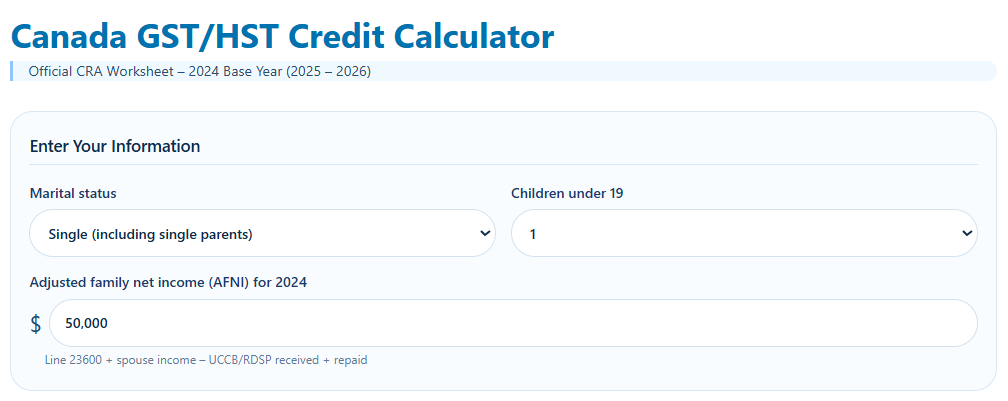
Filing your taxes on time + before April 30 + is important to get payment in time. Missing a filing deadline means missing payments until the CRA processes your return. Check out our tool at Canada Calculators to calculate your GST/HST Tax Credit in a very easy way.
Frequently Asked Questions (FAQ)
Is Canada Groceries and Essentials Benefit (CGEB) restricted to buying food?
No. Despite the name change from the GST/HST credit, the funds are deposited directly with zero spending restrictions. This allows recipients to use the payment for rent, bills, or any personal expenses.
How did the old GST credit to CGEB transition work?
The 5th January and 2nd April 2026 distributions were issued under the traditional GST/HST credit rules based on 2024 taxes. The July 3 and October 5, 2026 payments officially launched the enhanced CGEB rates based on 2025 tax returns.
What if my total annual CGEB entitlement is less than $200?
If your quarterly CGEB is less than $50 ($200 annual), the CRA does not split it across four cycles. It is provided as a single lump sum in July.
When will a young adult receive their first payment after turning 19?
As long as they filed their tax return for the preceding year, the CRA issues their first CGEB payment on the next scheduled quarterly payment date after their 19th birthday.
How do newcomers to Canada claim?
New residents do not need to wait until tax season. They can claim with Form RC151 (GST/HST and CGEB Application for individuals who become residents of Canada) directly to the CRA.
Can CRA stop CGEB payments to pay off personal tax debt?
Generally, the CRA does not automatically offset GST/CGEB payments against ordinary income tax debts, though credits may be redirected to settle certain fixed debts like outstanding child support enforcement orders.
How does a shared custody arrangement work for CGEB?
If parents share custody between 40% and 60% of the time, the CRA divides the credit 50/50, paying each parent half of the applicable child supplement based on their own adjusted net income.
Does CGEB replace provincial sales tax credits?
No, related provincial and territorial credits (such as the Ontario Trillium Benefit, BC Climate Action Tax Credit, or Saskatchewan Affordability Tax Credit) remain separate and will continue to be administered alongside or combined with federal payments.
What happens if I file my annual tax return after July?
Your quarterly payments will be paused until the CRA finishes processing your return. Once assessed, any missed tax return amounts are issued as a retroactive lump-sum adjustment on the next scheduled payment date.
What happens to future quarterly payments if a recipient is deceased?
CGEB payments belong to the individual. They are stopped upon death. Any payment received after the date of death must be returned to the CRA. However, an eligible survivor will have the household benefit recalculated under their own name.